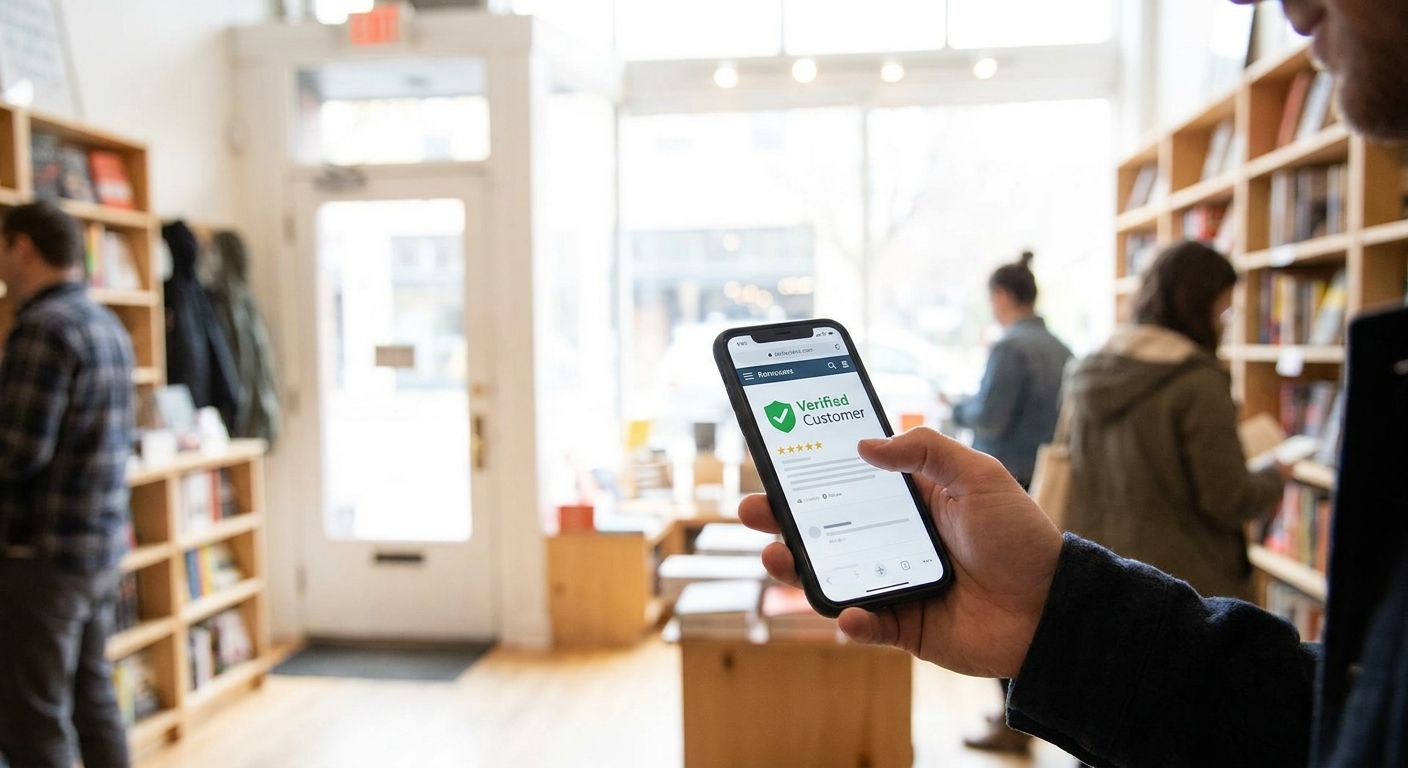
Verified reviews come from verified visits — you can't get one without the other, and 2026 storefronts that skip that order end up with flagged reviews or no reviews at all.
- Verified customer reviews require proof someone actually visited your store, not just clicked a link.
- Ask for the review inside a 10-minute window after a real, verified visit, not days later.
- Eveoy pays per verified visit at $24.99 and refunds no-shows, so every review request starts from a real person.
- Photo and video proof from a visit is the fastest way to turn a visitor into a review, then a repeat customer.
Why this matters
Google and Yelp don't reward review volume anymore — they reward reviews tied to real activity. A store with 40 reviews and zero foot traffic signals looks suspicious to both the algorithm and the shopper reading it on their phone in 2026.
The fix isn't a review-request template. It's getting a real person through the door first, then asking while the experience is still fresh. Everything below assumes you start with a verified visit, not a cold email list.
What you'll need
- A way to verify someone actually walked into your store — a POS timestamp, a photo, or a platform like Eveoy that requires photo/video proof and a 10+ minute in-store window
- A short, no-friction way to leave a review — a QR code at checkout or a receipt link, not a five-click form
- Your Google Business Profile and Yelp listing claimed and active
- A written script for staff — one sentence, said at the right moment, matters more than any app
- 15 minutes a week to check and respond to new reviews
The steps
1. Get real people in the door before you ask for anything
A review request only works if there's a real visit behind it. If your current traffic is thin, that's the actual problem — no review tactic fixes an empty store.
Eveoy pays $24.99 per verified visit, and the shopper has to spend 10+ minutes in your store and submit photo or video proof before you pay. No visit, no charge — it's refunded automatically. That gives you a pool of real, recent visitors to ask, instead of guessing who walked in last Tuesday.
Common mistake: buying generic foot traffic or ad clicks and expecting reviews to follow. Clicks don't walk into stores. Visits do.
2. Ask at the moment of highest satisfaction, not after they leave
The best time to ask for a review is while the customer is still in the store or within minutes of checkout — not in a follow-up email three days later. Satisfaction decays fast; memory of your product doesn't improve with distance.
Train staff to ask once, briefly: "If you liked this, a quick review helps us a lot." No pressure, no discount dangled for a 5-star rating — that violates most platform guidelines and gets reviews removed.
Common mistake: offering a discount in exchange for a review. Google and Yelp both strip incentivized reviews, and you lose the review and the trust.
3. Make leaving the review a 15-second action
A QR code on the receipt or counter that opens directly to your Google review form removes almost every excuse. If a customer has to search for your business name themselves, most won't finish.
Test the QR code on your own phone before printing 500 receipts with it — a broken link is the single most common reason review requests fail silently.
Common mistake: linking to your homepage instead of the review form directly. Every extra tap costs you a percentage of respondents.
4. Verify the visit before you count on the review
If you're running any paid or promotional foot traffic push, confirm the visit happened before assuming a review is coming. Platforms that require photo/video proof and a minimum dwell time — like Eveoy's verified-visit model — give you a paper trail you can point to if a review platform ever questions activity spikes.
That proof matters twice: once for your own records, and once if Google flags a sudden review cluster as suspicious.
5. Turn the photo or video proof into the review itself
A shopper who already took a photo of your storefront or product for a visit-verification platform is one step from turning that photo into a review. Ask them directly: "Mind posting that photo with a quick review?" You're not asking them to write from scratch — you're asking them to repurpose something they already made.
This is the fastest lane from foot traffic into user-generated content, and it works because the ask is small.
6. Respond publicly to every review, good or bad
A one-star review with no response looks worse than the review itself. A five-star review with a genuine two-line reply signals an active, real business — which is exactly what both shoppers and search algorithms are checking for in 2026.
Keep replies specific: mention the product or visit, not a copy-paste "Thanks for your feedback!" Generic replies read as fake as generic reviews.
7. Track review velocity against visit velocity
If verified visits are climbing but reviews aren't, the ask is broken — not the traffic. If both are flat, traffic is your bottleneck, not review strategy.
Check this monthly. A store running consistent verified visits should see a steady trickle of reviews, not a spike-and-silence pattern that platforms tend to flag.
Pay only for visits that show up
$24.99 per verified visit, refunded automatically if it doesn't happen.
Troubleshooting
Nobody leaves a review after visiting. The ask is happening too late or too indirectly. Move it to the moment of checkout and hand them the QR code, don't email it.
Reviews get flagged or removed. This almost always means an incentive was offered, or the reviewer never actually visited. Verified, un-incentivized visits are the only reliable fix.
Reviews mention the wrong location. Multi-location brands need a separate QR code and review link per store — one generic link splits your review count across the wrong listings.
Review count is growing but average rating is dropping. Look at what's actually happening in-store during those visits before assuming it's a review-collection problem — it's a product or service problem wearing a review disguise.
Slow, inconsistent trickle of reviews. Volume of real visits is usually the bottleneck, not your ask script. More verified traffic, same script, produces more reviews.
Competitors seem to have hundreds of reviews overnight. That's usually a red flag for incentivized or fake activity, not a benchmark to chase. Platforms increasingly penalize exactly that pattern in 2026.
Tools and resources
- Eveoy — pay-per-verified-visit platform, $24.99 per visit, photo/video proof required, refunded if the visit doesn't happen
- Your Google Business Profile dashboard — free, required for any review strategy
- A QR code generator pointed directly at your Google review form URL
- POS receipt customization to print the QR code automatically
- Restaurant-specific review tactics if you run a food or beverage storefront
What to do next
Once reviews start coming in consistently, shift focus to the traffic feeding them. Read how to increase foot traffic to your retail store to build the visit volume that makes this whole system compound instead of trickle.
FAQ
How do I get verified customer reviews for my store in 2026?
Get real people to visit your store first, then ask for a review within minutes of checkout using a QR code linked directly to your Google review form. Verified visits, not clicks or incentives, are what platforms count as legitimate in 2026.
Are incentivized reviews against Google's policy?
Yes, offering discounts or free items in exchange for reviews violates Google's review guidelines and Yelp's terms. Reviews collected this way get removed and can trigger a broader review audit on your listing.
What counts as a verified visit for review purposes?
A verified visit typically means proof someone was physically in your store, such as a timestamped photo or video and a minimum dwell time. Eveoy requires 10+ minutes in-store and photo/video proof before charging $24.99 per visit.
How much does it cost to generate verified foot traffic and reviews?
On Eveoy, verified visits cost $24.99 each and are refunded automatically if the visit doesn't happen. There's no cost for visits that never show up, only for shoppers who actually walk in and prove it.
Is it better to ask for reviews in-store or by email?
In-store asks convert far better because satisfaction is highest at that moment and the request takes 15 seconds with a QR code. Email follow-ups days later see lower response rates because the experience has already faded.
How do I stop fake reviews from hurting my store's rating?
Report fake reviews directly through your Google Business Profile and focus your own strategy on verified, un-incentivized visits so your legitimate reviews outweigh the noise. A steady stream of real reviews also makes fake spikes easier for you and the platform to spot.
Can user-generated content from visits double as reviews?
Yes, a photo or video a shopper already took as proof of a visit is an easy starting point for a review, since you're asking them to repurpose content instead of writing from scratch. This works especially well for beauty, food, and retail storefronts.
One last thing
The stores that get stuck aren't bad at asking for reviews — they're just asking people who never really visited. Fix the visit problem with real, verified foot traffic, at $24.99 a person with refunds on no-shows, and the reviews follow on their own within weeks, not months.