Fake reviews get flagged. Bought reviews get buried. The restaurants winning on Google and Yelp in 2026 are the ones that make it easy for real diners to leave real reviews — right after a real visit.
This guide ranks the methods that produce authentic reviews for your restaurant, from free habit changes to paid verified-visit platforms, with a verdict on each.
- Asking in person at peak satisfaction beats every automated request for how to generate authentic reviews for your restaurant.
- QR code table cards convert better than printed URLs — Buy this tactic first, it's free.
- Verified in-person visit platforms like Eveoy add photo-proof reviews for $24.99 per confirmed visit in 2026 — Consider for slow months.
- Buying reviews or running review-for-discount schemes gets accounts suspended on Google and Yelp — Skip entirely.
- Responding publicly to every review, good or bad, is the single habit that keeps 2026 review volume compounding.
Why this matters
Diners check reviews before they check the menu. A restaurant with a thin or stale review count loses the comparison the second a competitor two blocks over has fifty fresh ones from this year.
The problem isn't wanting reviews — it's that most tactics restaurants try either produce nothing (a static "leave us a review" sign nobody reads) or produce reviews that Google's spam filters quietly bury because they arrived in a suspicious burst with no purchase or visit history behind them. Authentic, in 2026, means traceable to a real visit. That's the filter every method below has to pass.
How this list is ranked
Each method is scored on three things: whether it ties the review to a verifiable visit, how much staff effort it takes to run every day, and whether it survives platform spam detection without getting flagged or removed. Tactics that rely on discounts-for-reviews or bulk review requests score low on that last point no matter how many reviews they produce short-term — platforms treat incentivized reviews as a policy violation, and a wave of them can trigger a review purge that erases the good ones too.
The ranking favors durability over volume. A method that adds eight verified reviews a month for a year beats one that adds forty in a week and then gets flagged.
The ranked list
1. Ask in person, at the moment of highest satisfaction
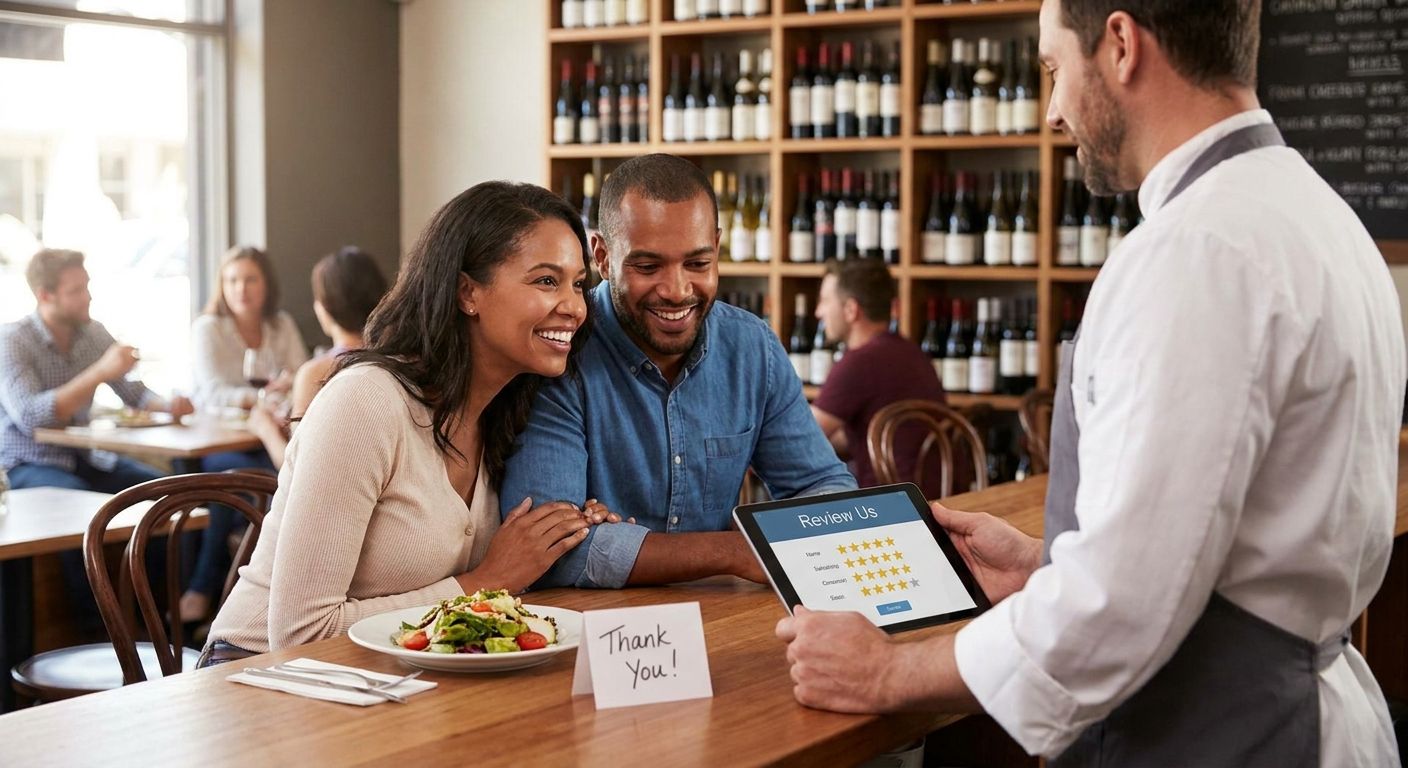
The hook: it's free and it's the highest-converting tactic on this list. The concrete detail: a server asking "mind leaving us a quick review?" while clearing plates converts far better than any follow-up text sent hours later, because the diner is still in the good mood the review needs to capture.
This works because review platforms weight recency and specificity — a review written minutes after a great meal names the dish, the server, the moment. A review written two days later says "food was good." Train front-of-house staff to ask only after a visibly positive interaction, never as a blanket script at every table.
Verdict: Buy. Zero cost, highest authenticity signal, works in 2026 exactly like it worked a decade ago.
2. QR code table tents and receipt codes
The hook: it removes every point of friction between "I liked this" and "I posted a review." The concrete detail: a QR code printed on the receipt or a small table tent takes a diner from phone-out to review page in one scan, versus typing a business name into a search bar.
Pair the QR code with a one-line prompt tied to the visit — "Just ate here? Tell us how it went" — not a generic "review us" ask. Rotate the placement every quarter so regulars don't tune it out.
Verdict: Buy. Cheap to print, easy to test, and it scales with covers served, not staff bandwidth.
3. Verified in-person visit platforms
The hook: this is the only method on the list that pays for the visit, not the review. The concrete detail: Eveoy charges $24.99 per shopper who walks in, stays 10+ minutes, and submits photo or video proof — refunded automatically if they never show up.
This solves the cold-start problem: a new location or a slow Tuesday doesn't have enough organic foot traffic to generate review volume on its own. Verified visits bring people through the door who then leave the kind of specific, photo-backed review that spam filters trust, because it's attached to a documented visit rather than an anonymous account posting from nowhere. Restaurants running slow shoulder seasons or a fresh opening use this to seed review volume while organic asks (methods 1 and 2) catch up.
Verdict: Consider. Not free, but it's pay-per-result — you're not paying for impressions or clicks, only for a person who actually walked in.
4. Automated post-visit review requests
The hook: it catches diners who forgot to review on the way out. The concrete detail: a text or email sent within two hours of a reservation or a POS transaction, linking straight to your Google Business Profile review page, keeps response rates highest while the meal is still fresh in memory.
Don't send it to every table — send it to diners who already gave positive verbal feedback or a high server tip, since that's a proxy for satisfaction the system can act on without asking directly.
Verdict: Buy. Automate it once, let it run, but keep the list filtered to likely-happy diners.
5. Respond publicly to every review
The hook: it's not a review-generation tactic on paper, but it's the one that compounds every other tactic on this list. The concrete detail: restaurants that reply to reviews — good and bad — within 48 hours see repeat reviewers at a noticeably higher rate than restaurants that never respond, because diners who feel heard come back and tell you again.
A short, specific reply ("Glad the brisket landed — that batch was a new rub we're testing") signals to future readers that a real person runs the account. That trust transfers directly to how much weight a new review carries.
Verdict: Buy. Free, takes ten minutes a day, and it's the habit most restaurants skip.
6. Fast-casual counter prompts and digital receipts
The hook: fast-casual formats move diners through faster than full-service, so the review ask has to happen in seconds, not minutes. The concrete detail: a prompt on the digital receipt or order-confirmation screen, timed to the second the order is marked complete, catches the customer while they're still standing at the counter.
This is a different playbook than sit-down service — there's no server moment to work with, so the ask has to live in the transaction itself. In-store marketing for fast-casual restaurants covers the foot-traffic side of this format in more detail.
Verdict: Buy. Low effort once it's built into the POS flow.
7. Post-meal surveys for buffet and cafeteria formats
The hook: high-volume, self-serve formats have the weakest natural review habit of any restaurant category, because there's rarely a single server interaction to trigger the ask. The concrete detail: a short survey at the exit — two questions, thirty seconds — captures satisfaction data you can convert into a review ask for anyone who rated the visit highly.
Buffet and cafeteria operators dealing with this exact gap can see the fuller acquisition picture in new customer acquisition for buffet and cafeteria restaurants.
Verdict: Consider. Works, but needs a staffed exit point or a kiosk to run consistently.
8. Review-for-discount schemes
The hook: it looks like the fastest way to generate volume. The concrete detail: offering a free appetizer or discount code in exchange for a review is an explicit violation of Google's and Yelp's review policies in 2026, and both platforms actively detect the pattern — a spike of five-star reviews tied to a promo code gets flagged, sometimes taking legitimate reviews down with it.
Verdict: Skip. The short-term bump isn't worth the platform risk.
Comparison table
| Method | Cost | Effort | Best for | Verdict |
|---|---|---|---|---|
| Ask in person | Free | Low, ongoing | Full-service | Buy |
| QR table cards | Low, one-time print | Very low | All formats | Buy |
| Verified in-person visits | $24.99 per confirmed visit | Low | New locations, slow seasons | Consider |
| Automated post-visit texts | Low, SMS platform fee | Low | Reservation-based dining | Buy |
| Public review responses | Free | 10 min/day | All formats | Buy |
| Fast-casual counter prompts | Low, POS integration | Low | Quick-service | Buy |
| Buffet exit surveys | Low, kiosk/staff time | Medium | Buffet, cafeteria | Consider |
| Review-for-discount | Free upfront, risky | Low | Nobody | Skip |
Bring in verified diners this month
Pay $24.99 only when a real shopper visits and proves it. No visit, no charge.
Where to start
- Fix the free stuff first. In-person asks, QR codes, and review responses cost nothing and take a week to set up — get those running before spending on anything else.
- Use paid verified visits to fill gaps, not replace organic asks. A slow opening month or a location with low walk-by traffic is where a pay-per-visit method earns its cost; a busy Friday night doesn't need it.
- Never mix incentives with the review ask. Keep any loyalty offer or discount separate from the review request itself — the moment they're linked, you're in policy-violation territory.
FAQ
What's the best way to generate authentic reviews for your restaurant in 2026?
Asking diners in person right after a positive interaction converts best and costs nothing. Pair it with a QR code on the receipt so the ask has an immediate, frictionless path to the review page.
Is it against the rules to offer a discount for a review?
Yes. Google and Yelp both prohibit incentivized reviews and can flag or remove them, sometimes along with other legitimate reviews from the same account activity.
How much does a verified in-person visit cost?
Eveoy charges $24.99 per shopper who visits and stays 10 or more minutes with photo or video proof, refunded automatically if the visit doesn't happen.
Do automated review request texts actually work?
They work best sent within two hours of the visit to diners who already showed signs of satisfaction, like a high tip or positive verbal feedback. Sent later or sent to everyone, response rates drop fast.
Why do some restaurant reviews get removed by Google?
Google removes reviews it flags as incentivized, bulk-posted, or tied to accounts with no verifiable activity. A sudden spike of similar five-star reviews is the most common trigger.
Should new restaurants pay for review generation?
A new location with no review history benefits from a paid, verified-visit method to seed early reviews while organic in-person asks build momentum. Established restaurants with steady foot traffic usually don't need it.
How fast should staff ask for a review after a meal?
Within minutes, while the diner is still at the table or the counter. Reviews requested same-day but hours later convert at a noticeably lower rate.
Does responding to reviews help generate more of them?
Yes. Diners who see a specific, human reply to their review are more likely to return and review again, which compounds review volume over time without any extra ad spend.
One last thing
The restaurants with the strongest review pages in 2026 aren't running one big campaign — they're stacking small, free habits (the ask, the QR code, the reply) and using a paid, verified method like Eveoy only to fill the gaps organic traffic can't cover on its own.