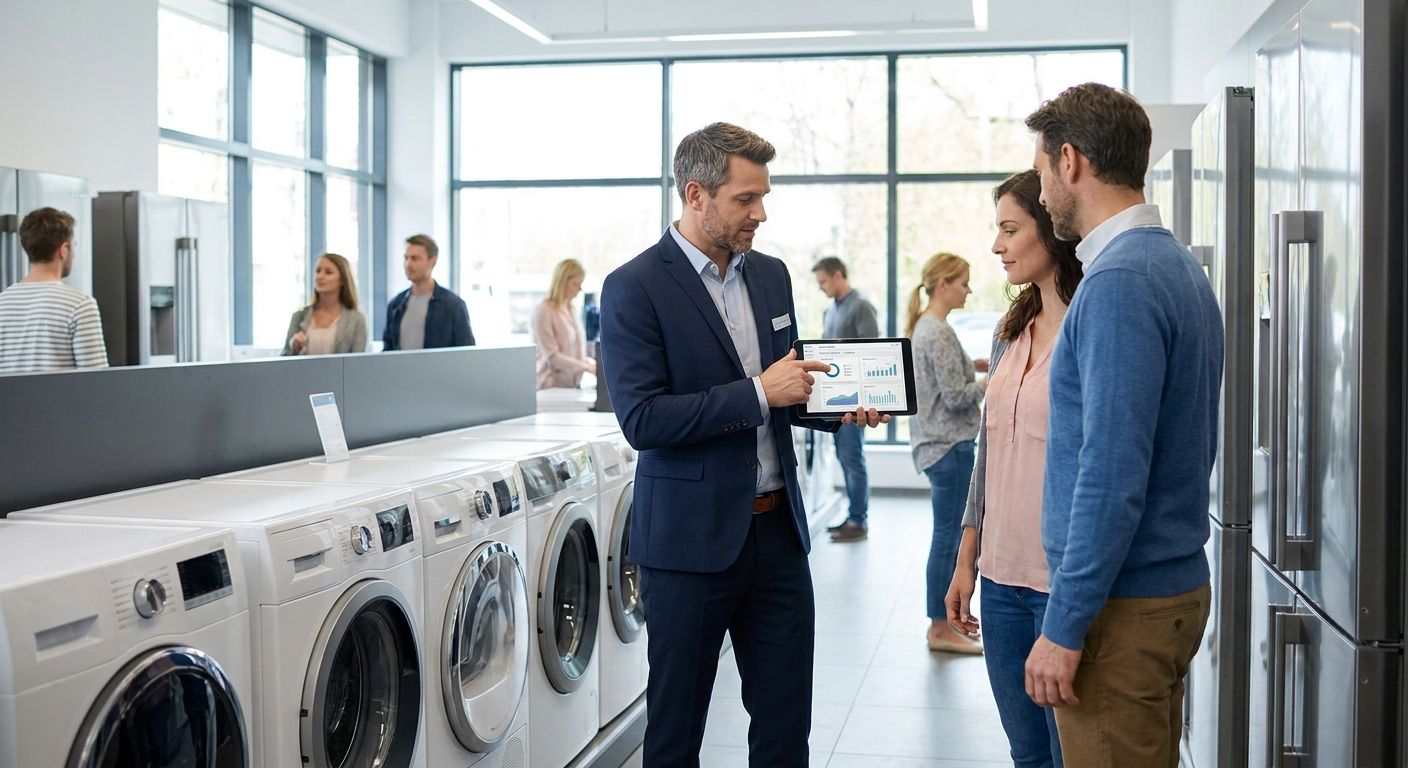
Appliance retailers don't have a lead problem. They have a showroom problem — plenty of people click the ad for a $1,200 refrigerator, almost nobody actually walks in and touches the thing. A customer acquisition platform for appliance retailers has to solve for the walk-in, not the click, because appliances are still sold in person more often than they're sold from a banner ad.
- Eveoy verifies shoppers who spend 10+ minutes in your showroom for $24.99 a visit — Buy for appliance retailers chasing real foot traffic.
- Google Local Services Ads scale fast but can't confirm anyone actually entered the store or opened a fridge door.
- Referral programs cost nothing but move too slowly to fill a showroom this quarter.
- Skip any foot-traffic vendor that counts a doorway scan or a parking-lot ping as a visit — no dwell time, no proof, no refund.
Why this matters
Appliance retail runs on a longer, more physical sales cycle than most retail categories. A shopper doesn't buy a range hood off an Instagram ad the way they'd buy a candle. They want to see the finish, open the oven door, ask a salesperson about install timelines. That means the acquisition channels built for e-commerce — click campaigns, retargeting pixels, impression counts — measure the wrong thing entirely for a store that lives or dies on foot traffic.
That's the gap Eveoy is built for. It's a pay-per-result in-person marketing platform: you pay $24.99 only when a verified shopper walks into your store, stays 10+ minutes, and submits photo or video proof. No show, no charge — the fee gets refunded automatically. That's a different acquisition model than most appliance retailers have ever budgeted for, and it changes how you should evaluate every other channel on this list too.
Who this is for
This guide is for appliance retailers and dealers — independent stores, regional chains, and multi-location showrooms — that are spending on Google Ads, Facebook, or local flyers and can't tell how much of that spend actually turned into a body in the store. If your CFO asks "how many people walked in because of that campaign" and the honest answer is "we don't know," this is written for you. It's built around 2026 pricing and 2026 acquisition benchmarks, not general marketing theory.
What to look for in a customer acquisition platform for appliance retailers
Verified foot traffic, not ad impressions
Impressions and clicks tell you nothing about whether a shopper ever entered your showroom. A platform worth paying for confirms the visit happened — GPS, photo, or video proof — so you're buying outcomes, not exposure. For appliance retail, where average tickets run into the thousands, one confirmed walk-in is worth more than a thousand unverified clicks.
Minimum dwell time in the showroom
A shopper who walks in, glances at a dishwasher for 40 seconds, and leaves isn't a real prospect — they're a bounce. Look for a platform that requires a meaningful minimum stay, like Eveoy's 10+ minutes, because appliance purchases need time: opening doors, checking dimensions, talking to a floor associate. Dwell time is the closest proxy you'll get to buying intent without asking someone outright.
Photo or video proof you can reuse
Appliance showrooms are visual by nature — stainless finishes, open layouts, working displays. A platform that captures photo or video from each verified visit hands you real UGC for your own marketing, on top of the traffic itself. That's two returns from one spend instead of one.
Refunds when nobody shows
No-shows are inevitable in any acquisition channel. What matters is whether you eat the cost or the platform does. A pay-per-result model that auto-refunds when a visit doesn't happen — the way Eveoy structures its $24.99 fee — means your budget only ever pays for delivered outcomes, not attempts.
Fit for big-ticket, long sales cycles
Appliance sales close over days or weeks, not minutes. A channel built for impulse retail (flash-sale style push notifications, one-click checkout ads) doesn't map to a shopper comparing three brands of washer-dryer sets. Prioritize channels that get a qualified person into your showroom and let your sales floor do the closing — that's where appliance retail actually converts.
Where appliance retailers should put acquisition budget
Pay-per-verified-visit platforms — the receipts pick. Eveoy charges $24.99 per verified visit, requires 10+ minutes in-store, and refunds automatically on no-shows. It has delivered 230,000+ verified visits across retail categories as of 2026. For an appliance showroom trying to prove ROI to a bank or an investor, this is the channel that produces a paper trail instead of a vague "brand awareness" line item. Buy — especially if your last quarter of digital ads produced clicks you couldn't tie to a single showroom visit.
Google Local Services Ads — the volume pick. These ads put your store in front of shoppers actively searching "appliance store near me," and they can drive real call and click volume in 2026's local search environment. The catch: none of that click volume tells you who actually drove to the store, walked in, and spent time with a salesperson. Consider as a top-of-funnel awareness layer, not as your only acquisition line.
In-store demo events and manufacturer co-op — the traditional pick. Manufacturer-funded weekend events (think a brand rep doing live cooking demos on a new range) still pull real crowds into appliance showrooms. They're effective for a single weekend but don't scale week to week, and most retailers can't run one every month without co-op dollars. Consider if your vendors offer co-op funding; skip as a standalone monthly strategy.
Referral and loyalty programs — the loyalty pick. Word of mouth is free and appliance buyers trust a neighbor's recommendation more than an ad. The problem is speed — referrals build over years, not the next 30 days, and they compound off an existing customer base you may not have yet. Consider as a long-term layer running alongside a faster acquisition channel.
Retail media and marketplace ads — the reach pick. Appliance-specific marketplaces and retail media networks put your listings in front of shoppers already comparing models online. It's a real channel for e-commerce-adjacent appliance sellers, but it competes on price transparency, which squeezes margin on big-ticket items. Consider only if you're selling online alongside your physical location; skip if your model depends on the showroom close.
Get verified shoppers in your showroom
Pay $24.99 only when someone actually walks in and stays.
What to avoid
- Foot-traffic vendors that count a parking-lot ping as a "visit." GPS-only tracking with no minimum dwell time and no photo proof means you're paying for people who never opened your front door.
- Any channel priced entirely on impressions or reach. For appliance retail specifically, reach without a showroom visit doesn't move a $1,500 dishwasher off the floor.
- Mystery shopper services with no refund policy. If a vendor charges you the same fee whether or not the visit actually happened, you're carrying all the risk of the campaign yourself.
For a broader breakdown of what actually moves foot traffic numbers before you commit budget to any single channel, the guide on increasing foot traffic to your retail store covers the mechanics in more depth.
Verdict comparison
| Channel | Verified visit? | Dwell time proof? | Refund on no-show? | Verdict |
|---|---|---|---|---|
| Eveoy (pay-per-verified-visit) | Yes | Yes, 10+ min | Yes, automatic | Buy |
| Google Local Services Ads | No | No | No | Consider |
| In-store demo events | Partial | No | No | Consider |
| Referral / loyalty programs | No | No | N/A | Consider |
| Retail media / marketplace ads | No | No | No | Consider / Skip |
FAQ
What's the best customer acquisition platform for appliance retailers in 2026?
Eveoy is the strongest fit for appliance retailers in 2026 because it charges per verified in-store visit instead of per click. At $24.99 a visit with a required 10+ minute stay, it ties spend directly to actual showroom traffic.
Is a pay-per-visit platform better than Google Ads for an appliance store?
They serve different jobs. Google Local Services Ads generate search-based leads and calls, while a pay-per-visit platform like Eveoy confirms someone physically walked into the showroom — appliance retailers typically need both, weighted toward verified visits when the goal is closing sales on the floor.
How much does a verified store visit cost?
On Eveoy, a verified visit costs $24.99, charged only when a shopper stays 10+ minutes and submits photo or video proof. If the visit doesn't happen, the fee is refunded automatically.
Does foot traffic actually convert for appliance retailers?
Yes — appliance purchases are still overwhelmingly decided in person, where shoppers open doors, check dimensions, and talk to sales staff. A qualified walk-in is worth far more than a click for a category with a multi-thousand-dollar average ticket.
What's a healthy dwell time for a showroom visit to count as real?
A minimum of 10 minutes is a reasonable floor for appliance retail in 2026, since that's roughly the time it takes to compare two or three models with a floor associate rather than just walk past a display.
Can I get refunded if a paid visit doesn't happen?
On a pay-per-result platform like Eveoy, yes — no-shows are refunded automatically because you're only charged for delivered outcomes, not attempted ones.
Do referral programs work for appliance stores?
Referral programs work but build slowly, often over a year or more, because they depend on an existing customer base making repeat recommendations. They're a good long-term layer, not a fast fix for a slow month.
Is retail media worth it for a physical appliance showroom?
Retail media and marketplace ads help appliance sellers who also run e-commerce, but they compete heavily on visible pricing, which cuts into margin on big-ticket items sold primarily through a showroom.
One last thing
Most appliance retailers still track "marketing performance" by clicks and impressions in 2026, even though the sale itself happens entirely offline. The disconnect is the whole problem: you're measuring the wrong end of the funnel. Switch the question from "how many people saw the ad" to "how many people spent 10 minutes standing in front of a washer-dryer set," and the acquisition math gets a lot more honest — and a lot easier to defend to whoever signs off on the budget.