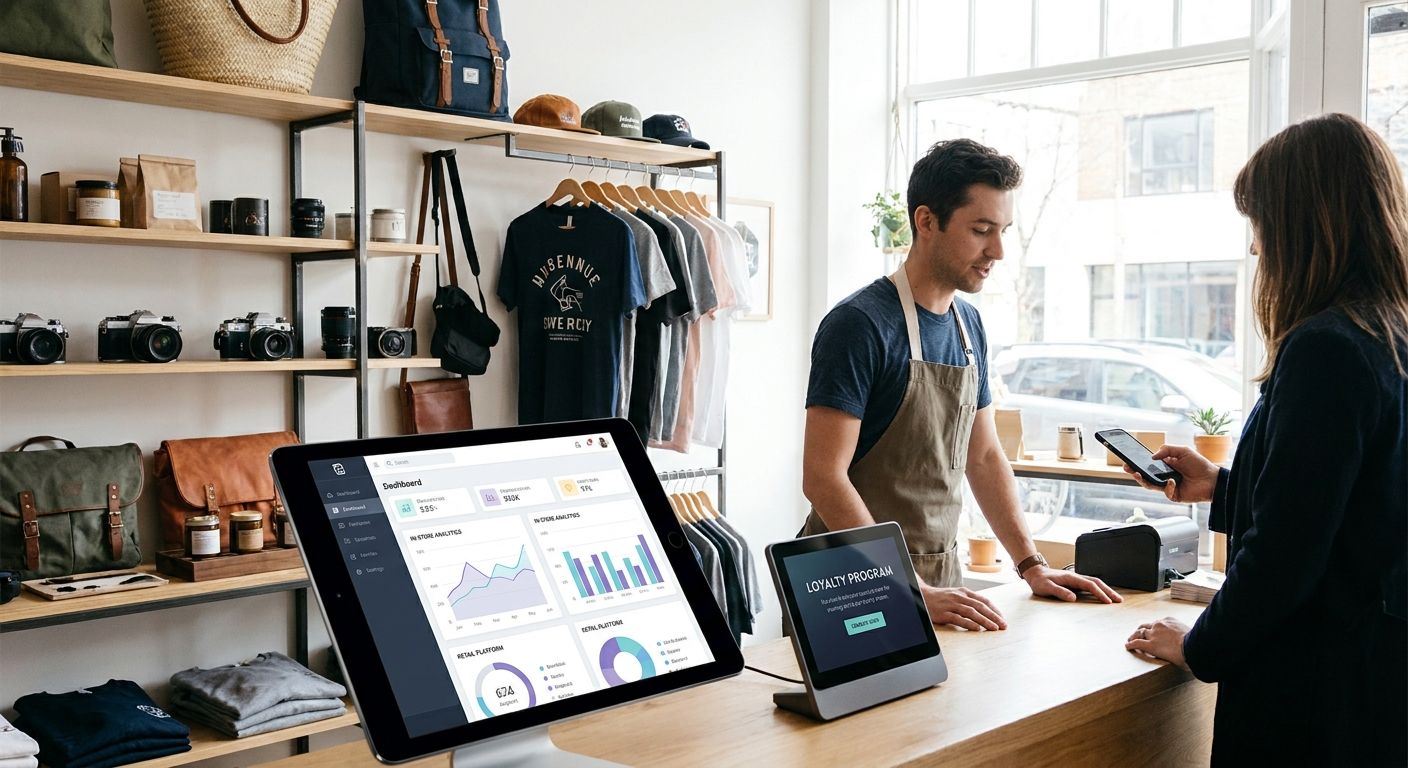
Clothing boutiques don't have a discovery problem. They have a walk-in problem. Ads get clicks, Instagram gets likes, and the fitting rooms stay empty — this guide breaks down what an actual retail marketing platform for clothing boutiques needs to do to fix that.
- A real retail marketing platform for clothing boutiques pays for verified store visits, not clicks — Eveoy charges $24.99 per shopper who stays 10+ minutes. Buy.
- Boutiques selling kids' or family apparel should prioritize segment-specific traffic campaigns over generic foot-traffic ads. Consider.
- Resale and vintage boutiques need repeat-visit reactivation, not one-time discovery traffic. Consider.
- Skip platforms that charge for impressions or 'reach' with no proof a person entered the store in 2026.
Why this matters
Most boutique owners already tried the standard playbook: Instagram ads, a local Facebook boost, maybe a Google listing bump. None of it puts a body through the door. Eveoy built the alternative on a simple rule — you pay when someone actually shows up, spends 10+ minutes in your store, and submits photo or video proof. No visit, no charge, refunded automatically.
That distinction matters more for clothing boutiques than almost any other retail category. Apparel is a touch-and-try business. A shopper who never enters the store never feels the fabric, never tries the fit, never becomes a repeat buyer. A retail marketing platform for clothing boutiques has to be judged on one metric: did a real person walk in.
Who this is for
This is for boutique owners and small apparel chains who are done paying for ad impressions that never turn into a customer standing at the register. It fits independent clothing shops, kids' and family apparel stores, resale and vintage boutiques, and small multi-location retailers trying to prove foot traffic to a landlord or investor. If your store lives or dies on people physically walking in and trying things on, this is the buyer profile the platform is built for.
What to look for in a retail marketing platform for clothing boutiques
Proof of an actual store visit
Any platform that reports "impressions" or "reach" without proof someone entered your store is measuring the wrong thing. Look for photo or video verification tied to the visit — that's the difference between a marketing report and a marketing receipt.
Dwell time, not just a door count
A shopper who walks in and leaves in 90 seconds didn't try anything on. Platforms that require a meaningful minimum stay — 10 minutes or more — filter out drive-by traffic and force real browsing behavior.
Pay-for-result pricing
Boutiques run on thin margins. A flat monthly ad spend with no guarantee of visits is a bet. A per-visit price with an automatic refund when nobody shows up is a transaction — you know exactly what a customer walking through your door cost, in dollars, every time.
UGC you can reuse
Every verified visit that produces a photo or video is content you didn't have to shoot yourself. For apparel, that's someone in your clothes, in your store, which is exactly the kind of proof that gets people to try you next.
Segment fit
A kids' clothing store and a vintage resale shop need different campaign framing even on the same platform. Look for whether the platform lets you target by category — family apparel, resale, general retail — instead of running the same generic traffic push for every store type.
Repeat-visit potential
One-time traffic is nice. A platform built around getting someone to walk in once, so they can decide on their own whether to come back, is worth more long-term. The paid visit is the introduction, not the whole relationship.
Top picks
The general-traffic pick. For any clothing boutique that just needs more feet through the door, foot traffic marketing built for retail stores covers the baseline case: pay-per-verified-visit, $24.99 a visit, photo proof required. Buy — this is the default starting point in 2026 for a boutique with no traffic campaign running yet.
The family-apparel pick. Stores selling kids' and family clothing have a different shopper — often a parent making a fast, practical decision, not a browser. Foot traffic campaigns tuned for children's clothing stores target that buyer specifically instead of running a one-size-fits-all retail push. Buy if kids' or family apparel is a meaningful share of your inventory.
The content-engine pick. If your boutique needs Instagram-ready photos and video more than it needs raw traffic, look at how foot traffic converts into user-generated content — every verified visit comes with proof media you can repost. Buy if your social feed is thin and you're tired of staging your own flat-lays.
The resale and vintage pick. Resale and vintage boutiques depend on repeat visits more than first-time discovery, since inventory turns over constantly. Foot traffic strategies for thrift and resale stores are built around getting shoppers back in regularly, not just once. Consider — strong fit if your model depends on repeat browsing, less critical if you sell one core line that doesn't rotate.
The wildcard. Running a per-visit campaign purely as a landlord or investor proof point — showing documented foot traffic to justify a lease renewal or a funding round — works, but it's a narrower use case than driving sales. Consider, not a first move for most boutiques.
“No clicks. No bots. Just receipts.”
What to avoid
- Platforms that price on impressions. An impression never tried on a jacket. If a platform can't tell you whether someone physically entered your store, it's an ad tool wearing a foot-traffic label.
- "Engagement" metrics with no photo or video proof. Likes and shares don't fill fitting rooms. Anything reported without visual evidence of an actual visit is unverifiable and, for a boutique, useless.
- Generic retail campaigns with no segment targeting. A campaign built for hardware stores doesn't speak to a kids' clothing shopper or a vintage buyer. If a platform runs the same script for every retail category, it's not built for boutiques specifically.
See real visits, not clicks
Pay $24.99 only when a verified shopper walks in and proves it.
Verdict comparison
| Pick | Best for | Cost model | Verdict |
|---|---|---|---|
| General retail foot traffic | Any clothing boutique | $24.99 per verified visit | Buy |
| Children's clothing campaigns | Kids/family apparel stores | $24.99 per verified visit | Buy |
| UGC-focused campaigns | Boutiques needing content | $24.99 per verified visit | Buy |
| Thrift/resale traffic | Resale and vintage shops | $24.99 per verified visit | Consider |
| Investor/landlord proof runs | Multi-location or leased stores | $24.99 per verified visit | Consider |
FAQ
What is a retail marketing platform for clothing boutiques?
It's a tool that drives verified in-person store visits instead of clicks or impressions. Eveoy charges $24.99 per shopper who walks in, stays 10+ minutes, and submits photo or video proof.
How much does Eveoy cost per visit?
Each verified visit costs $24.99 in 2026. If the shopper doesn't show up or doesn't meet the dwell-time and proof requirements, the charge is refunded automatically.
Is a pay-per-visit platform better than paid social ads for a boutique?
For driving physical store traffic, yes — social ads charge for clicks whether or not anyone visits, while pay-per-visit models only charge when a real person walks in and proves it.
Does this work for kids' and family clothing stores specifically?
Yes, campaigns can be targeted to family and children's apparel shoppers rather than run as a generic retail push, which matters because the buyer decision process is different.
Can a resale or vintage boutique use this kind of platform?
Yes, though resale stores get more value from repeat-visit strategies since inventory turns over constantly and one-time traffic matters less than return visits.
What proof does a boutique get for each paid visit?
A photo or video submitted by the shopper confirming they were in the store for at least 10 minutes, which doubles as content the boutique can reuse.
What happens if a shopper doesn't actually visit?
The $24.99 charge is refunded automatically — boutiques never pay for a visit that didn't happen.
Does this replace social media marketing for a boutique?
No, it feeds it — every verified visit produces UGC that boutiques can post, turning paid foot traffic into ongoing organic content.
One last thing
The part boutique owners underestimate: the paid visit isn't the goal, it's the introduction. Nobody's charged extra when a shopper comes back on their own — and in apparel, where fit and feel decide the sale, getting someone through the door once is usually the whole battle. In 2026, that's the entire bet a retail marketing platform for clothing boutiques should be making.