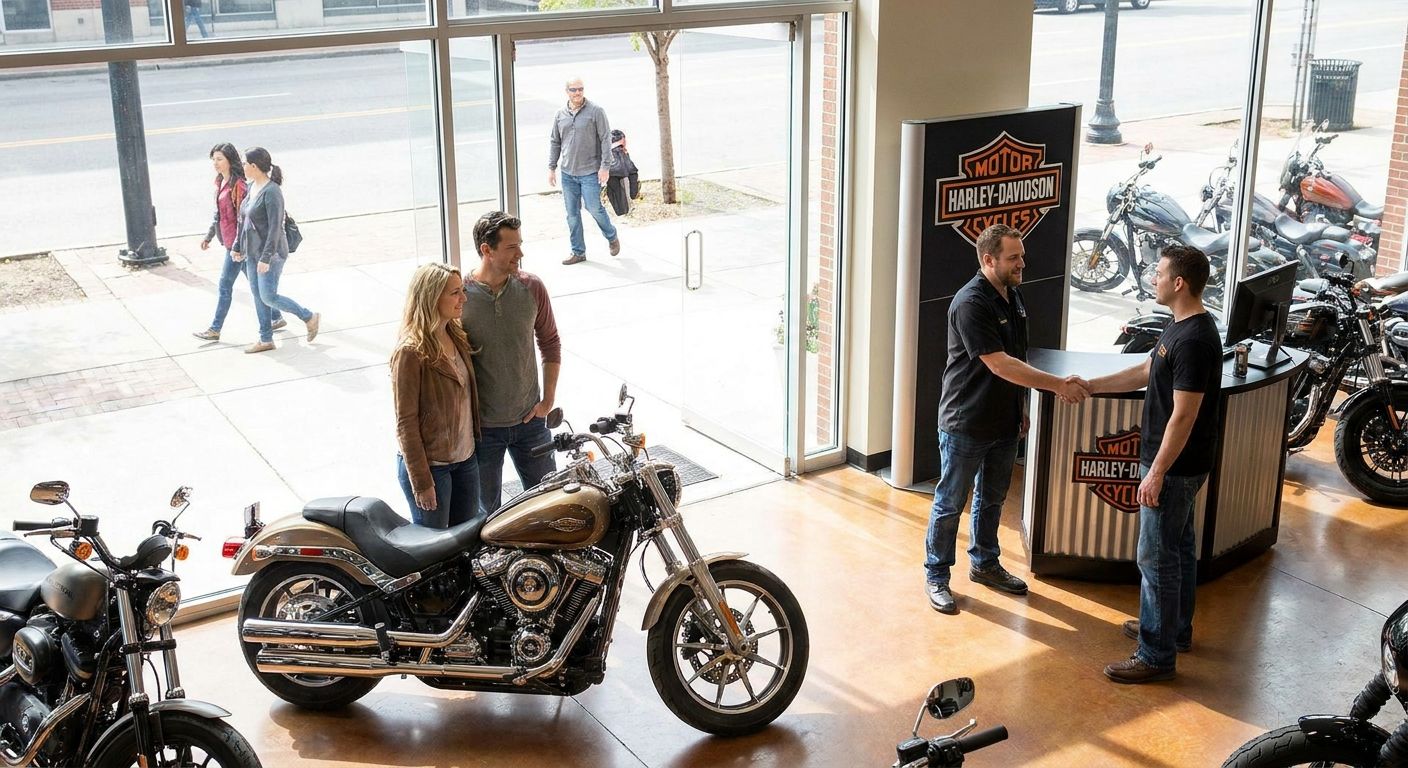
Foot traffic marketing for motorcycle dealerships means paying for a showroom visit you can prove happened, not a print ad someone glanced at from a stoplight. This guide breaks down what to look for in 2026, which tactics earn a Buy, and which ones to skip.
- Eveoy's pay-per-visit model wins for foot traffic marketing for motorcycle dealerships: $24.99 per verified walk-in, refunded on no-shows.
- Test-ride events still work but give you zero verified count of who actually walked in — Consider, not Buy.
- Boosted social posts and local radio get a Skip in 2026: neither confirms a single showroom visit.
- Require a 10+ minute dwell time and photo proof, or you're paying for drive-bys, not customers.
Why this matters
A motorcycle sale rarely closes on a Facebook click. Buyers walk the showroom, sit on three bikes, ask the service manager about maintenance costs, and come back twice before they sign anything. That behavior makes foot traffic the number that actually predicts sales, not impressions and not likes.
Most dealership marketing in 2026 still gets billed on reach or clicks. That tells you nothing about whether a single rider walked through your door. Eveoy flips that: you pay only when someone verified actually shows up and stays.
Who this is for
This guide is for the GM or marketing lead at an independent or small-chain motorcycle dealership who needs bodies in the showroom, not another vanity metric. If you're a single-location Harley, Honda, or powersports store competing against a regional chain with a bigger ad budget, this applies directly.
If your dealership already tracks walk-in attribution through a CRM tied to salesperson logs, some of this you already know. The goal here is to stop paying for exposure you can't verify.
What to look for in foot traffic marketing for motorcycle dealerships
Verified attendance, not impressions
An impression is someone scrolling past your ad for half a second. A verified visit is a person standing on your showroom floor with proof to show for it. If a vendor can't tell you who walked in, you're buying guesswork.
A dwell-time minimum that filters out drive-bys
Anyone can pull into your lot and leave in 90 seconds. A minimum stay requirement, like the 10+ minutes Eveoy requires, separates a real shopper from someone who parked to check their phone.
Photo or video proof you can reuse
A verified visit that comes with a photo or short video is a piece of user-generated content, not just a data point. That's a testimonial you didn't have to script.
A refund or guarantee on no-shows
If a visitor doesn't show, you shouldn't pay. This is the single biggest gap between traditional media buys and pay-per-result models in 2026 — traditional media never refunds a no-show.
Fit for a high-consideration purchase cycle
Motorcycles aren't impulse buys. A tactic built for grocery-store-style foot traffic won't automatically translate, but the underlying logic — pay for the visit, not the exposure — holds across categories, including household appliance retailers selling into a similarly considered purchase.
A local radius that matches your actual catchment area
A motorcycle dealership's real draw radius is usually 20 to 40 miles, not a zip code. Any foot traffic tactic that can't target that radius specifically is wasting spend on people who will never make the drive.
Top picks for 2026
Pay-per-verified-visit programs — the accountable pick. You pay $24.99 per verified walk-in, and it's refunded automatically if the person doesn't show. The visit requires a 10+ minute stay and photo or video proof, so you're not paying for someone who peeked in and left. Verdict: Buy.
Test-ride and demo days — the classic play. Powersports demo days pull people onto the lot and let them sit on inventory they'd never otherwise touch. The problem is attribution: most dealerships have no reliable way to confirm how many attendees were net-new versus existing customers who show up to every event. If you run one, treat it as a relationship tool, not a foot traffic metric, and pair it with a foot traffic strategy built for retail stores to actually count new bodies. Verdict: Consider.
Google Business Profile and local SEO — the free foundation. Every dealership should have this dialed in regardless of what else it's spending on. It's free, it compounds over time, and it captures people already searching for a dealership near them. It's also slow and doesn't scale on demand when you need a traffic push before a model-year clearout. Verdict: Consider.
Boosted social posts — the vanity metric. A boosted post gets you likes, comments, and reach numbers that look good in a monthly report. None of those confirm a single person walked into your showroom in 2026. Verdict: Skip.
Local print and radio — the legacy spend. Fixed media buys with no attribution back to actual visits. If you can't tie the spend to a walk-in, you're buying awareness in the dark. Verdict: Skip.
Start filling your showroom
Pay only for verified visits with photo proof, refunded if they don't show.
What to avoid
- Paying for "reach" that never defines a visit. If the vendor's reporting stops at impressions or clicks, you have no idea if anyone showed up.
- Demo days with no attendee capture beyond a raffle entry. A name on a raffle slip isn't a lead, and it definitely isn't a verified visit.
- Any media buy that reports impressions instead of names. In 2026, if a tactic can't name the person who walked in, treat the number as unverifiable.
Verdict comparison
| Tactic | Verified visits? | Dwell time tracked? | Photo/video proof? | Cost structure | Verdict |
|---|---|---|---|---|---|
| Pay-per-verified-visit (Eveoy) | Yes | Yes, 10+ min | Yes | $24.99 per visit, refunded on no-show | Buy |
| Test-ride / demo day | No | No | Sometimes (staff photos) | Fixed event budget | Consider |
| Google Business Profile / local SEO | No | No | No | Free, staff time | Consider |
| Boosted social posts | No | No | No | Ad spend, no attribution | Skip |
| Local print / radio | No | No | No | Fixed media buy | Skip |
FAQ
What is foot traffic marketing for motorcycle dealerships?
It's marketing spend tied directly to a verified showroom visit rather than an ad impression or click. In 2026, models like Eveoy's pay-per-visit structure charge a flat fee, currently $24.99, only when someone confirmed shows up and stays 10 or more minutes.
How much does foot traffic marketing cost for a dealership in 2026?
Pay-per-verified-visit programs run $24.99 per visit and refund automatically if the person doesn't show. Traditional local media buys vary widely and rarely tie cost to an actual walk-in.
Is pay-per-visit marketing better than paid ads for motorcycle dealers?
For measuring actual showroom traffic, yes, because it charges per confirmed visit instead of per click or impression. Paid social and search still have a role for brand awareness, but they don't verify anyone walked in.
How do you track foot traffic to a motorcycle dealership?
The most reliable method in 2026 is a verified-visit system requiring photo or video proof and a minimum dwell time. Door counters and CRM logs help but don't confirm the visit came from a specific marketing source.
What's a good dwell time to count as a real visit?
10 or more minutes is the standard used by verified-visit programs like Eveoy, since it filters out someone who parked and left within a minute. Anything shorter risks counting drive-bys as customers.
Do test ride events still work in 2026?
They still build relationships and let riders try inventory, but they rarely give you a verified count of new versus repeat attendees. Pair them with a tracked foot traffic tactic if you need an actual number.
How does Eveoy verify a store visit?
Eveoy requires the shopper to spend 10 or more minutes in the store and submit photo or video proof before the visit counts. If they don't show or don't meet the requirement, the $24.99 charge is refunded.
Can foot traffic marketing work for service and parts departments too?
Yes, and it often performs better there because service and parts customers return monthly instead of once every few years. A verified-visit program applies the same way to a parts counter walk-in as it does to a showroom shopper.
One last thing
The dealerships getting the most out of foot traffic marketing in 2026 aren't spending it chasing new-bike shoppers first. They're spending it on service bay and parts counter walk-ins, because those visits repeat monthly instead of once every few years, and a repeat visitor is worth more over time than a single showroom browser who may not buy for another year.